%20(3600%20x%20400%20px)%20(2).png)
.png)
Pendulum Dowsing
Pendulum dowsing is a divination and intuitive practice that uses a suspended weighted object, known as a pendulum, to seek guidance, answers, or energetic insight. The pendulum is typically attached to a chain, cord, or string and may be made from crystal, metal, wood, glass, or stone. During a session, the pendulum is allowed to swing freely while the practitioner asks questions or focuses on a specific topic. Many people use pendulum dowsing for spiritual guidance, energy work, meditation, decision-making, intuitive development, locating objects, or identifying energetic imbalances. Some practitioners believe the pendulum responds to subtle energies, intuition, subconscious awareness, or spiritual communication. Others view pendulum dowsing as a psychological tool connected to unconscious muscle movements and focused intention.
A Brief History of Pendulum Dowsing
The practice of dowsing has ancient roots and has appeared in many cultures throughout history. Early forms of dowsing were often used to locate underground water, minerals, or hidden objects using rods, branches, or suspended tools. Historical evidence suggests that dowsing practices existed in parts of ancient China, Egypt, Greece, and medieval Europe.
By the Middle Ages, dowsing rods were commonly associated with finding water sources and mineral deposits. Over time, pendulums became connected not only with physical searching but also with spiritual and occult practices. During the 19th and 20th centuries, pendulum dowsing became increasingly linked to mysticism, energy healing, spiritualism, and metaphysical traditions. Practitioners began using pendulums for personal guidance, chakra work, and intuitive readings rather than solely for locating physical objects.
Today, pendulum dowsing remains popular within spiritual communities, holistic wellness practices, and modern divination traditions.
Some scientists and skeptics explain pendulum movement through the ideomotor effect, a psychological phenomenon in which small unconscious muscle movements occur without deliberate awareness. According to this explanation, the pendulum responds to subtle physical motions generated by expectation, focus, or subconscious thought. Others maintain spiritual or energetic interpretations of pendulum dowsing, believing the practice taps into intuition, higher consciousness, or unseen energies. Because of these differing perspectives, pendulum dowsing exists at the intersection of spirituality, psychology, symbolism, and personal belief.
Some practitioners use pendulum dowsing to explore possible future outcomes or gain insight into upcoming situations. Questions may focus on relationships, career choices, emotional decisions, or spiritual paths. In many traditions, the pendulum is believed to reveal energetic tendencies or likely outcomes based on present circumstances rather than fixed and unchangeable predictions. Readers often emphasize that personal choices and actions can influence future events, making pendulum guidance a tool for reflection and awareness rather than absolute certainty.

Understanding Pendulum Dowsing
What is a Pendulum?
A pendulum is a weighted object suspended from a chain or cord that swings freely in response to movement. Pendulums come in many shapes and materials, including: crystal points, metal weights, carved stones, wooden forms, or glass pendants. Some practitioners choose pendulums based on aesthetics or personal connection, while others select materials believed to carry specific energetic properties. Popular crystals used in pendulums include:
-
amethyst
-
clear quartz
-
rose quartz
-
obsidian
-
labradorite
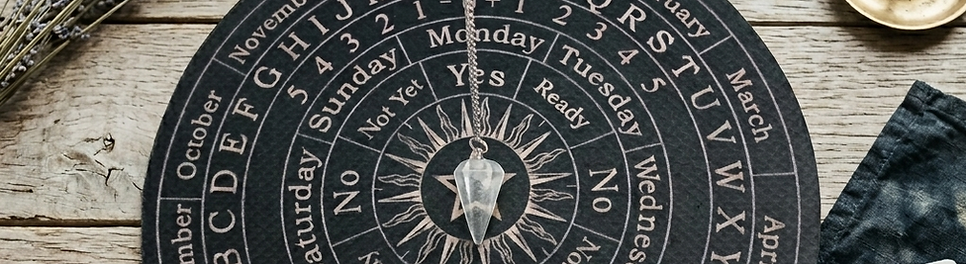
Some practitioners use pendulum charts or boards to expand beyond simple yes-or-no answers. The pendulum swings toward areas of the chart believed to contain relevant answers or energies. These charts may include numbers, letters, percentages, emotional states, chakra systems, or timing indicators, among other things. Pendulum boards are often used in:
-
spiritual readings
-
energy healing
-
meditation sessions
-
intuitive exercises
-
forward and backward = yes
-
side to side = no
-
circular motion = unclear or maybe
How Pendulum Dowsing Works
During a pendulum session, the practitioner typically holds the pendulum still above a surface and asks questions aloud or silently. The pendulum begins to move in different directions, which are interpreted as responses.
Before beginning, many practitioners establish what each movement means. For example:
-
forward and backward = yes
-
side to side = no
-
circular motion = unclear or maybe
The meanings can vary between individuals and practices.
Basic Steps in Pendulum Dowsing
-
Relax and focus the mind.
-
Hold the pendulum steady.
-
Ask simple questions.
-
Observe the direction of movement.
-
Interpret the response.
Many beginners start with straightforward yes-or-no questions before exploring more detailed forms of dowsing.
Tips for Beginners
People new to pendulum dowsing often begin with simple exercises to build familiarity and confidence.
Helpful beginner practices include:
-
using calm and quiet environments
-
asking clear questions
-
avoiding emotionally charged topics at first
-
practicing regularly
-
recording sessions in a journal
Many practitioners also cleanse or recharge pendulums through methods such as moonlight exposure, meditation, incense, or crystal placement.